Torrey, Utah / Where to stay / Camping
One developed campground, two free ones, and four up the mountain
Capitol Reef Camping
Capitol Reef camping comes down to seven campgrounds and one rule almost nobody knows until they are told to switch their generator off. Fruita is the one everybody wants, 71 sites in an orchard meadow, reservable six months out. This page covers it site by site, then the two free primitive campgrounds, the four forest campgrounds 3,000 feet higher, and the dispersed camping rule that half the internet states backwards.
If you read one section
Which of the seven you should be booking
Fruita is the right answer for most people, and it is the only developed campground inside the park: flush toilets, running water, a dump station, grass, shade and a five minute walk to the orchards. It is $25 a night, it takes reservations on recreation.gov up to six months ahead, and since October 2024 it is reservable year round rather than first come first served in winter.
Choose something else in three situations. If Fruita is full, which it is most of April, May, September and October. If you need a generator running in summer, because of the rule in the next section. Or if you are here in July and August, when the forest campgrounds up Boulder Mountain sit at 7,200 to 8,800 feet and sleep twenty degrees cooler than the valley.
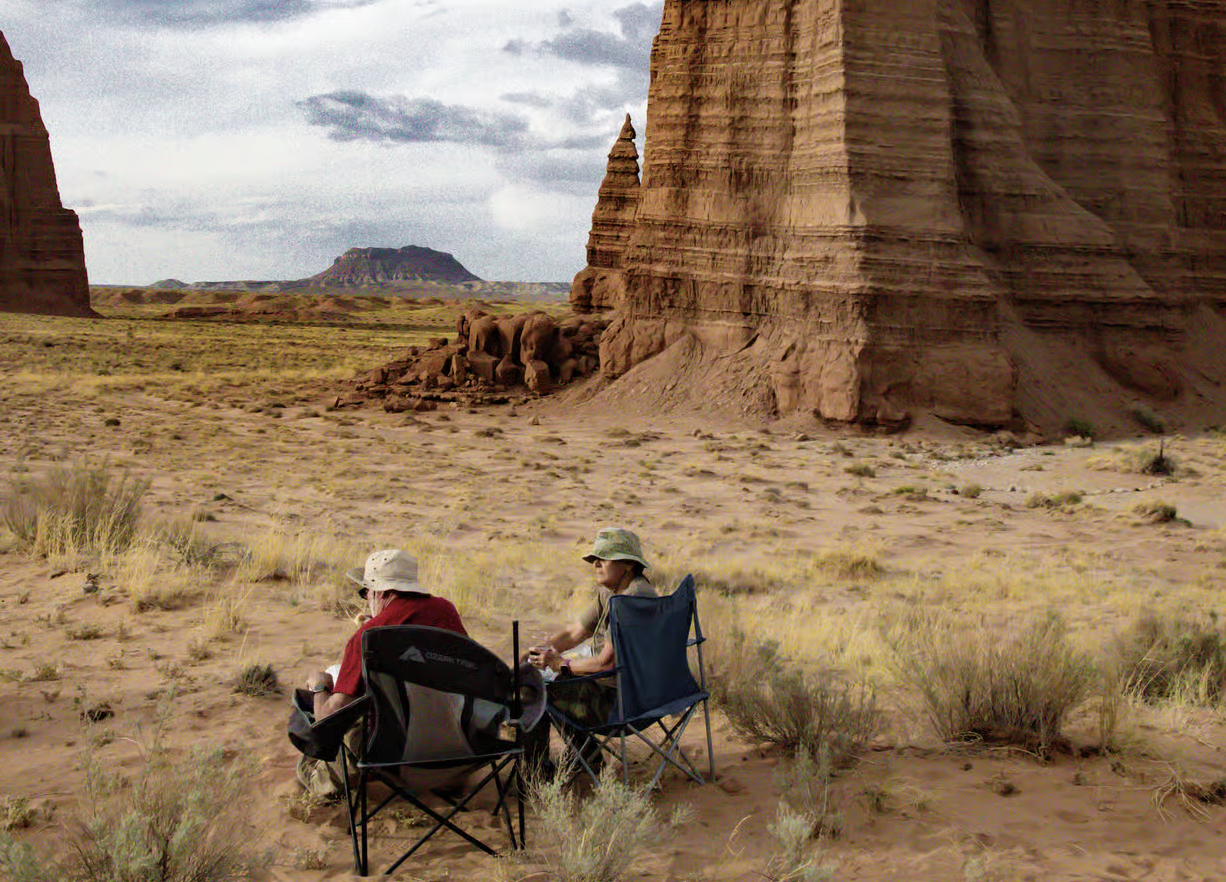
The two free primitive campgrounds inside the park, Cathedral Valley and Cedar Mesa, are a different kind of night: eleven sites between them, a pit toilet, a fire grate, no water and no reservation. They are worth planning for, not falling back on, and one of them needs the right vehicle.
Not committed to a tent? The lodging overview compares camping against the motels and cabins, the hotels page names every Torrey property, and cabins and glamping sits in between.
The one everybody wants
Fruita Campground, loop by loop
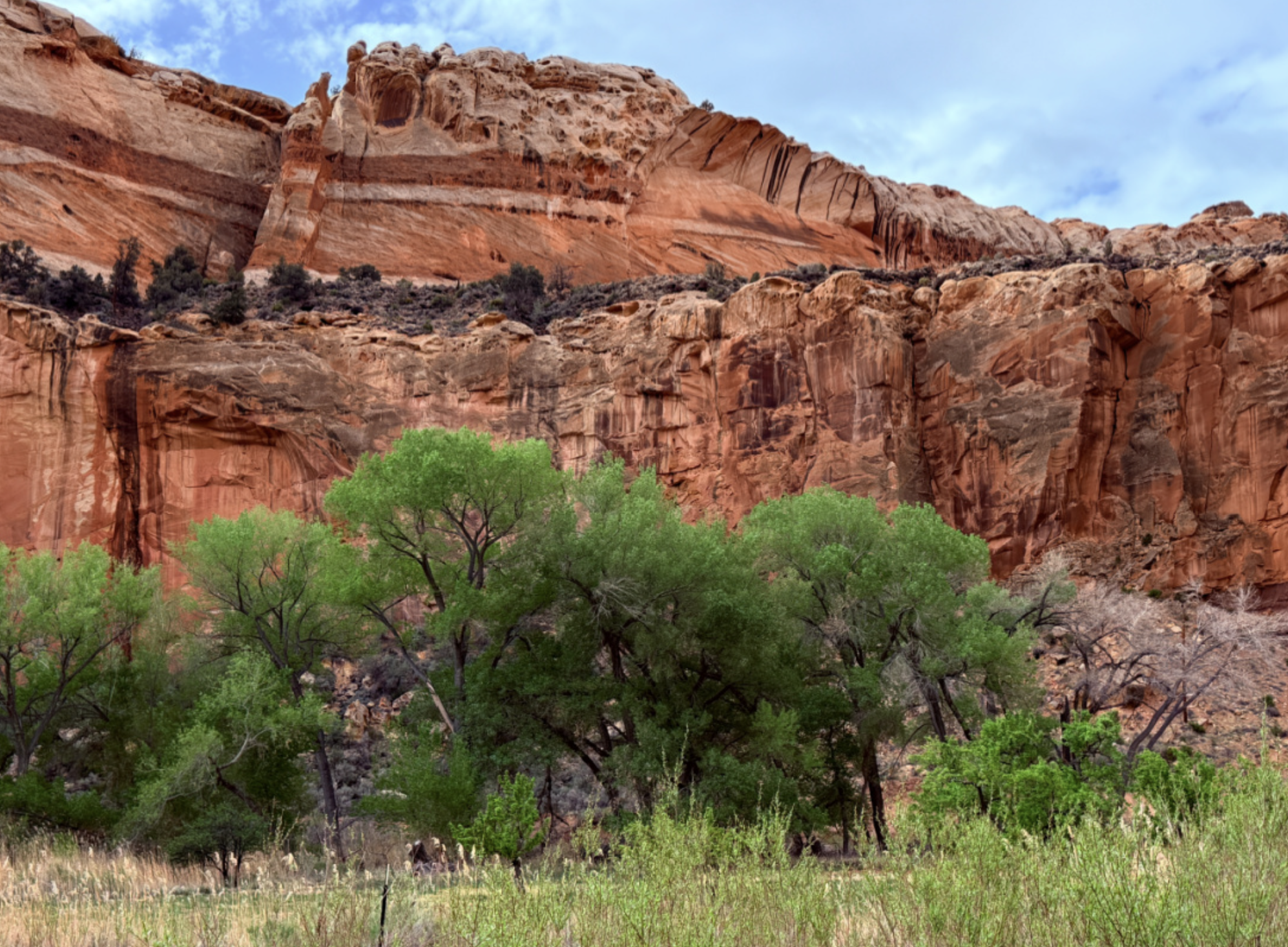
Three loops, 71 numbered sites plus a handful of walk in tent sites, in the irrigated meadow where the Fremont River runs below the cliffs. The loops are not interchangeable and the differences decide bookings.
| Loop | Season | What it holds | Who it suits |
|---|---|---|---|
| Loop A | Open year round | Numbered sites including the two campground host sites, 1 and 2. Dump station and RV water refill sit between Loops A and B | Winter campers, since it stays open when Loop C shuts, and anyone who wants to be nearest the services |
| Loop B | Open year round | Numbered sites plus five walk in tent sites | Tent campers who would rather carry gear a short distance than park beside it |
| Loop C | March 1 to the end of November. The bath house closes in mid November and the loop closes to camping December 1 | Most sites are 40 to 52 feet long. Two walk in tent sites | Larger rigs and trailers, and anyone who needs a generator between March and December |
Every site has a picnic table and a fire grate. None has individual water, sewage or electrical hookups, with one exception worth knowing: sites 14, 24 and 63 are accessible sites with an electrical connection provided for required medical devices only. If someone in your party sleeps on a machine, those three sites are the reason to book early rather than hope.
Restrooms have running water and flush toilets. There are no showers anywhere in the campground. The dump station and RV water tank refill between Loops A and B are free to use with a campsite reservation and $5 otherwise. Payment is cashless, so cards only.
How to actually get a site
The booking window opens six months to the day ahead on recreation.gov. For the spring and fall peaks, that is the morning to be online. Shoulder weeks in late June and midwinter are often bookable a week out, and winter still has genuine walk up availability even though the whole year is now reservable.
What Fruita gives you that nowhere else does
Position. You are inside the orchards, on foot from the Gifford House, the visitor center and the trailheads for the Fremont River Trail and Cohab Canyon. No driving in at dawn, no fee gate at first light, and deer through the meadow most evenings.
Read before you book, not after
Three rules that change plans
Generators are Loop C only for nine months of the year
This is the rule that surprises people. The park states that from March 1 to December 1, generators are only permitted in the C loop. Not quiet ones, not briefly, not in Loops A and B at all. In winter, when Loop C is closed, generators are permitted in Loops A and B instead.
So if you run a generator, whether for air conditioning, a CPAP without an electrical site, or work, your summer booking has to be Loop C. Within the permitted loop, hours are 8 am to 10 am and 6 pm to 8 pm on Mountain Daylight Time, and 8 am to 10 am and 5 pm to 7 pm on Mountain Standard Time.
The stay limit depends on which official source you read
The park's campground regulations give two limits by season: 14 days from March 1 to November 30, and 30 days from December 1 to February 28. Recreation.gov, which is where you book the same campground, states a 14 day stay limit per year.
Those are not the same rule. A month of winter camping is either permitted or it is not, depending on which federal page you happened to land on. We are not going to pretend to resolve it: if you are planning a long winter stay, call the park at 435 425 3791 and get it confirmed by a ranger before you book, because the booking system and the regulations disagree in writing.
Food storage is a rule, not a suggestion
Food must be stored in a vehicle or an animal proof hard sided container at all times unless it is being prepared or eaten. Wood gathering is not permitted anywhere in the park, so bring firewood or buy it seasonally at the Gifford House or in Torrey. Beyond that: eight people per site, quiet hours 10 pm to 6 am, check in 3 pm, checkout 11 am, and pets on a leash six feet or shorter.
Parking is limited to whatever fits your designated space without extending into the road. A truck and a trailer count as two vehicles, which is the detail that catches people towing.
Forty people, one site
The Fruita group campsite
There is a single group site, and for a family reunion, a scout troop or a corporate group it is the best value in the area: $125 a night for up to 40 people, with two covered pavilions, designated tent pads, restrooms, grills, fire pits and an outside sink.
It has four constraints that matter. It is open from mid April to mid October, with the exact dates set annually. It is closed every Tuesday and Wednesday night for maintenance, so a five night stay has to be planned around that. Bookings run on a 12 month rolling window from the day of arrival, so you can reserve a year out, which you should. And the total vehicle count cannot exceed ten, with a truck and trailer counting as two.
Maximum stay is five nights. Generator use follows the 8 am to 10 am and 6 pm to 8 pm pattern. For groups also booking activities, the guided trips page lists which operators take larger parties and what the ratios look like.
Closed Tuesday and Wednesday nights is unusual and easy to miss. A Monday to Friday reunion does not work here. Thursday to Monday does.
Free, and better than it sounds
Cathedral Valley and Cedar Mesa
Eleven sites between them, no fee, no reservations, no water. Both are inside the park and both are hours from the nearest streetlight, which is the point.
| Campground | Sites | Elevation | Where | Vehicle |
|---|---|---|---|---|
| Cathedral Valley | 6 | About 7,000 ft | Roughly halfway around the Cathedral Valley Loop Road in the park's Cathedral District | The park states high clearance four wheel drive is usually necessary |
| Cedar Mesa | 5 | 5,500 ft | About 23 miles south of Utah State Highway 24 on the Notom Bullfrog Road | Usually two wheel drive can reach it, though high clearance is sometimes needed |
Both give you a picnic table and a fire grate at each site, a pit toilet, and nothing else. No water at either, so carry everything you will drink and cook with. Both cap occupancy at eight visitors and no more than two vehicles per site. Both are first come first served with no reservations, which in practice means arriving early in spring and fall and almost never being turned away in midsummer, when the heat sends people up the mountain instead.
Cedar Mesa is the easier of the two to reach and the more overlooked, sitting under the Waterpocket Fold with the Henry Mountains on the horizon. Cathedral Valley is the one people dream about, and it is also the one where getting there is the whole question. Read the road conditions page before you commit, because two official park pages give different vehicle guidance for that loop, and the Cathedral Valley page covers the route itself and the operators who drive it.
Neither campground has water, cell service or any way to call for help. Cathedral Valley in particular is a long way from a tow truck on a road that turns to slick clay in rain. Tell someone your plan, carry more water than you think you need, and check the road line at 435 425 3791 the morning you go.
The July and August answer
Four forest campgrounds up Boulder Mountain
Twenty minutes from Torrey, Scenic Byway 12 climbs into aspen and spruce on the Dixie National Forest. These are Forest Service campgrounds at 7,200 to 8,800 feet, and in high summer they are the more comfortable night by a wide margin.
| Campground | Distance | Sites | Elevation | Facilities |
|---|---|---|---|---|
| Sunglow | 18 mi | 9 | 7,200 ft | Drinking water, flush toilets. Sits above Bicknell in a red rock amphitheater |
| Singletree | 22 mi | 33 | 8,200 ft | Drinking water, flush toilets, two group sites. The biggest and the easiest to book |
| Pleasant Creek | 28 mi | 19 | 8,800 ft | Drinking water, pit toilets. 25 foot maximum, so no large rigs |
| Oak Creek | 30 mi | 9 | 8,800 ft | Drinking water, pit toilets. Best suited to tents |
The elevation gain is the whole argument. Fruita sits in the valley where July highs average 91 degrees. Singletree is 8,200 feet, and a rough rule of three to five degrees cooler per thousand feet of climb puts it far more comfortable on the same afternoon. The tradeoff is a drive to the park each morning and a season that does not include winter.
These figures come from a park publication comparing camping alternatives, which carries a 2020 date. Site counts and elevations do not move, but fees, opening dates and reservation systems do, so confirm current details with the Dixie National Forest or on recreation.gov before you rely on them. The Byway 12 page covers the drive, and the Boulder Mountain page covers what there is to do up there.
Late September and October reverse the logic. The forest campgrounds start freezing at night and closing for the season while Fruita is at its best. Check the month by month page for the thirty year temperature record that decides this.
Get this one right
Dispersed camping, stated correctly
There is no dispersed camping inside Capitol Reef National Park. Outside it, on Bureau of Land Management and Forest Service ground, there is plenty, and the rule reads like this in the park's own words: on BLM and USFS lands, you must camp within 150 feet of officially designated routes, and only on existing spur roads.
Read that twice, because a great deal of travel writing states it backwards as a requirement to camp at least 150 feet away from roads. It is the opposite. The 150 feet is a maximum distance, not a setback. You stay close to the designated route and you use ground that has already been driven on, because the point of the rule is to stop new tracks spreading across the desert rather than to hide campers from view.
Camping in previously disturbed areas outside developed campgrounds is what is permitted. Cutting a new spur to a nicer spot is not, and in this landscape a single set of tire tracks across cryptobiotic soil crust lasts decades.
Backpacking inside the park is separate again and requires a free backcountry permit before you start. The permits page covers which activities need one and where to get it.
Fires are the risk that ends dispersed camping seasons. Restrictions change through the summer on both BLM and Forest Service ground and they are not always posted at the turnoff. Check current fire restrictions the day you arrive rather than the week you booked.
Straight answers
Camping questions
Can I reserve the Fruita Campground, and how far ahead?
Yes. All sites are reservable on recreation.gov year round, up to six months in advance. That changed in October 2024, before which winter camping was first come first served with fee envelopes. Payment is cashless now, so cards only.
How much is camping at Capitol Reef?
Fruita is $25 per night, or $12.50 with a Senior or Access pass. The group site is $125 per night for up to 40 people. Cathedral Valley and Cedar Mesa are free. The park entrance fee is separate and covered on the fee page.
Are there showers at the Fruita Campground?
No. Restrooms have running water and flush toilets, but there are no showers anywhere in the campground. There is a dump station and RV water tank refill between Loops A and B, free with a campsite reservation and $5 without.
Can I run a generator at the Fruita Campground?
Only in Loop C from March 1 to December 1. In winter, when Loop C is closed, generators are permitted in Loops A and B. Hours are 8 am to 10 am and 6 pm to 8 pm on Mountain Daylight Time, and 8 am to 10 am and 5 pm to 7 pm on Mountain Standard Time.
How long can I stay at the Fruita Campground?
The park's campground regulations say 14 days from March 1 to November 30 and 30 days from December 1 to February 28. Recreation.gov states a 14 day limit per year for the same campground. The two official sources disagree, so confirm with the park at 435 425 3791 before planning a long stay.
Is the campground open in winter?
Yes. Loops A and B stay open all year and are reservable. Loop C runs March 1 to the end of November, with its bath house closing in mid November and the loop closing to camping December 1.
Are there accessible campsites?
Yes. The park states that four campsites at Fruita are fully accessible by wheelchair and designated for wheelchair users, and that accessible sites sit adjacent to restrooms. Sites 14, 24 and 63 have an electrical connection provided for required medical devices only. No other site has water, sewage or electrical hookups.
Do I need four wheel drive to camp at Cathedral Valley?
The park's primitive campground page states that high clearance four wheel drive is usually necessary to reach it. Another park page describing the same loop road says high clearance without four wheel drive can usually manage. Plan for the stricter of the two and call the road line at 435 425 3791 the morning you drive.
Can I camp anywhere outside the park for free?
On BLM and Forest Service land, in previously disturbed areas outside developed campgrounds, you must camp within 150 feet of officially designated routes and only on existing spur roads. That is a maximum distance from the road, not a minimum, which is the opposite of how it is often written.
Is there a campground with hookups near Capitol Reef?
Not inside the park. Full hookup sites exist at private RV parks in and around Torrey. We are naming and comparing those on the lodging pages rather than guessing at counts and rates here.
Site counts, loop seasons, fees, stay limits, generator and quiet hours, occupancy limits, primitive campground details and the dispersed camping rule on this page come from the National Park Service, primarily campground regulations and the primitive campgrounds page, plus recreation.gov for the Fruita listing, checked September 2026. Where two official sources disagree, this page says so rather than choosing for you.
Next step
Book the site, then fill the days
A campsite inside the park is the hardest thing to get here and the easiest thing to build a trip around. Sort it first, then everything else follows.
Also useful: the night sky above the campground, getting here and the entrance fee. Or who writes this site.