Torrey, Utah / Plan / With kids
Fruit you can pick, a canyon you can walk, and one badge to earn
Capitol Reef With Kids
Capitol Reef with kids is easier than the other Utah parks, mostly because the best part of it is a flat green orchard meadow rather than a rim you have to keep them away from. The Park Service names exactly one trail as kid friendly and does not rate any trail for children at all. This page gives you that trail, the ones we would add and why, the Junior Ranger details, and the safety list worth reading before you go.
If you read one section
A good day here is a meadow, a canyon and a badge
The three things that work with children almost regardless of age are the Fruita orchards, the walk up Capitol Gorge and the Junior Ranger booklet. Add the Gifford House at the end for pie and you have a day that keeps everyone happy without asking a six year old to climb 1,100 feet.
Entry is free for everyone under 16, so the fee is per vehicle rather than per head. Fourth graders can get a free national parks pass through the Every Kid Outdoors program, which covers the whole car.
What to be realistic about: this is a desert park with cliffs, washes and no shade in the middle of the day. The Park Service's own safety page says please watch your children and keep them close, which appears under the heading about steep cliffs, and it means what it says.
Working out the shape of the day? The one day page has the parking clock and real round trip trail distances, both of which matter more with children in the car.

What the park says, and what we would add
Trails with children
The Park Service rates every trail Easy, Moderate or Strenuous and has no category for children. Across all its Capitol Reef pages it recommends exactly one trail for kids by name. We have marked that clearly, so you can see which line is the park's judgment and which is ours.
| Trail | Round trip | Park rating | Does the park call it kid friendly? | Our read |
|---|---|---|---|---|
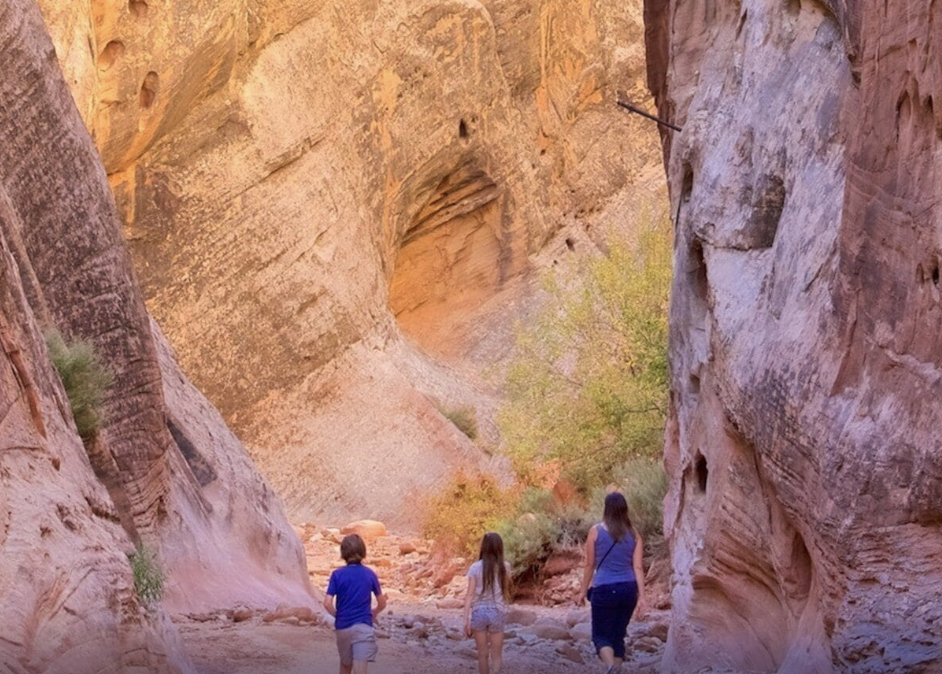
| Capitol Gorge | 2.0 mi, 80 ft | Easy | Yes, by name | Flat sand between huge walls, with pioneer names carved in the rock to hunt for. The one we would start with |
| Goosenecks | 0.2 mi, under 50 ft | Easy | No | Two minutes from the car to a genuine drop. Hold hands, and it buys you a big view for almost no walking |
| Sunset Point | 0.8 mi, under 50 ft | Easy | No | Level, short, and the best light of the day. Drop offs at the end, so the same rule applies |
| Grand Wash | 4.4 mi, 200 ft | Easy | No | Nearly flat and you can turn around at any point, which is the real advantage with kids. Never enter it if storms are anywhere in the forecast |
| Hickman Bridge | 1.8 mi, 400 ft | Moderate | No | The reward is excellent and the climb is short but real. Works well from roughly age seven upward |
| Fremont River | 2.0 mi, 480 ft | Moderate | No | Starts flat beside water through the campground, then climbs hard. Walk the flat part and turn back, which is a fine outing on its own |
| Cassidy Arch | 3.4 mi, 670 ft | Strenuous | No | The park describes it as climbing steeply with some exposure along high cliffs and ending on top of the arch. Not one we would take young children on |
| Rim Overlook | 4.6 mi, 1,110 ft | Strenuous | No | Ends on top of 1,000 foot cliffs. A great hike for teenagers who already walk, and wrong for anyone smaller |
Two honest notes on that table. All park distances are published one way, so the round trip column above is the doubling, not the park's figure. And "our read" is exactly that: a guide's judgment, not a rating the Park Service would endorse. You know your own children better than either of us.
The Sulphur Creek route is the one place the park does mention children, and it is a warning rather than a recommendation: it says the route may be difficult for children if deep water is present. It is also not an official maintained trail, and it needs a shuttle. The hiking page covers that route properly.
Free, and better than it sounds
The Junior Ranger badge, by age
Booklets are free at the visitor center, the program starts at age three, and the number of activities required scales with age. That last part is the bit parents rarely know in advance, and it is what makes the program work for a mixed age family.
| Age | Activities to complete |
|---|---|
| 3 to 5 | Choose 4 |
| 6 to 8 | Choose 6 |
| 9 to 11 | Choose 8 |
| 12 to 14 | Choose 10 |
| 15 and up | Complete all 12 |
Completing the booklet earns a signed certificate and a free badge. One activity requires either attending a ranger led program or watching the park film, so build that into the day rather than discovering it at 4 pm.
You can download and print the booklet before you arrive, which is worth doing if you have a long drive in. The badge still has to be collected in person, since a park employee reviews the finished booklet. The park also publishes the booklet in thirteen languages besides English, which is unusual and genuinely useful for visiting families.
The park film is called Watermark and it plays at the visitor center. The Park Service does not publish its running time, so do not build a tight schedule around it.
Almost nobody mentions this
Ripple Rock Nature Center and the ranger programs
Ripple Rock Nature Center
The park runs a dedicated children's facility 0.9 miles south of the visitor center on the Scenic Drive, staffed by interns who put on hands on programs covering American Indian culture, pioneer history, geology, paleontology, astronomy and wildlife. Junior Ranger activities happen here too.
It is a summer operation. The park's kids page describes programs running from late May through mid August, while a park news release gives daily hours of 9:00 am to 5:00 pm from Memorial Day through Labor Day. Those two do not quite match, so check at the visitor center when you arrive rather than driving down on a guess.
Ranger led programs
Year round the park offers a Ranger's Choice talk, 30 minutes, daily. From mid May to mid October it adds an archeology talk, an evening program at the campground amphitheater several nights a week running 45 to 60 minutes, and an astronomy program several nights a week with constellation tours and telescopes.
Topics, times and locations are posted at the visitor center and on campground bulletin boards, and the park notes they can change at short notice for weather. It does not publish whether these need booking, so ask when you arrive. The evening programs are a good use of a night for families staying at the Fruita campground.
The astronomy programs are the sleeper hit of a family trip here. Torrey and the park sit under some of the darkest skies in the country, and a telescope plus a ranger beats almost anything else you can do with children after dinner. The dark sky page covers what you can see and when.
The thing they will remember
Picking fruit, and the ladder rule
You can walk into any unlocked orchard and eat ripe fruit there at no charge, in any season, whether or not anything is officially open for harvest. That single fact is the most child friendly thing in the park, and it costs nothing.
Taking fruit home is different and only allowed from orchards posted open for picking. When one is open the park provides hand pickers and ladders, and there are two rules it states plainly. Never climb these historic trees. And children should not use ladders unsupervised.
The ladders are tripods, which behave differently from a stepladder, and the ground under a flood irrigated orchard is softer than it looks. The park's own guidance is not to stand on the top three rungs and not to lean to either side. With small children the better division of labor is obvious: an adult on the ladder, a child holding the bag.
Harvest windows the park will commit to are apricots late June to mid July, peaches late July to early September, pears early August to early September and apples mid August to mid October. Whether anything is open today is a phone call: 435 425 3791, press #1 for visitor information then #5 for the fruit hotline. The orchard page lists all 19 orchards and what grows in each.
Fenced orchards are open 9:00 am to 5:00 pm and unfenced ones from dawn to dusk. The meadow around them has grass, shade, picnic tables and a river, which is worth more to a tired family than another viewpoint.
Not the fun part, but the useful part
The four things that actually hurt people here
Cliff edges
The park's guidance is to stay on the trail, not to approach cliff edges, and to be aware of edges when using cameras and binoculars. Under that same heading it says please watch your children and keep them close. Falls from cliffs on trails can result in serious injuries or death.
Cassidy Arch is the one trail the park singles out for exposure along high cliffs. Rim Overlook ends on top of 1,000 foot cliffs. Both are wonderful and neither is a place to be managing a distracted five year old.
Flash floods
Most common in July, August and September but possible any time. The park's line is the one to remember: if thunder roars, get out of the gorge. It also warns that flood water can travel from many miles away with travel times of ten hours or more, which means blue sky above you is not information.
Grand Wash and Capitol Gorge are both washes and both are easy walks, which is exactly why families are in them at the wrong moment.
Heat and water
Carry one gallon per person per day. That is the park's figure and it includes children, who dehydrate faster than adults and are worse at saying so. Hike early or late and limit activity in the middle of the day.
July highs average 91 degrees with almost no shade on the trails. A 9 am start is not fussiness in summer, it is the difference between a good day and a bad one.
The drive itself
There is no cell service in the park and the Park Service says not to rely on a GPS unit to guide you in. Seat belts or child safety seats are required for all occupants. The nearest medical care is the Wayne Community Health Center in Bicknell, which offers basic medical and dental care and a pharmacy.
Nothing here is alarming. It is a small park with a good road through it. But it is an hour from anywhere, and that is worth knowing before you need it.
For the smallest visitors
Strollers, wheels and flat ground
The Park Service never uses the word stroller anywhere we could find, so take what follows as our reading of its accessibility information rather than an official recommendation.
Two surfaces are described as accessible and both are flat and hard. The Fremont Culture petroglyphs along Highway 24 are accessible by boardwalk. And a portion of the Fremont River Trail near the Gifford House and Fruita Campground is wheelchair accessible. Those are the two places a pushchair will work without a fight.
Also accessible: the visitor center, with a ramped entrance, reserved parking and accessible restrooms. The Fruita Schoolhouse and the Merin Smith Implement Shed, both with audio guides. The picnic area on the Scenic Drive, with reserved accessible parking and an accessible restroom. Many scenic overlooks and wayside exhibits. And four campsites at Fruita that are fully accessible by wheelchair.
What is not accessible: ranger led hikes and walks, which the park says are generally not accessible due to rugged terrain. And the orchards themselves, which are mown grass rather than paved and can be wet or soft when the irrigation is running.
With a baby or toddler, the honest version of this park is the Scenic Drive from the car, the orchards on foot, the petroglyph boardwalk and the meadow. That is a genuinely good day and it involves no hiking at all.
Straight answers
Family questions
Is Capitol Reef good for young children?
Better than most Utah parks, because its centerpiece is a flat orchard meadow with grass, shade, picnic tables and a river rather than a canyon rim. Add the Capitol Gorge walk and the Junior Ranger booklet and you have a full day that does not depend on anyone hiking far.
Which trail does the park itself recommend for kids?
Capitol Gorge. The Park Service calls it a kid friendly hike in a canyon that was the original road through the park up until 1962, and points out the Pioneer Register where travelers carved their names in the rock. It is 2.0 miles round trip on flat ground with 80 feet of elevation change.
Do children pay the entrance fee?
No. Children under 16 do not need an entrance pass. The standard fee is $20 per private vehicle and covers everyone in it for seven days. Fourth graders can also get a free annual pass through the Every Kid Outdoors program.
What age is the Junior Ranger program for?
Ages three and up. Booklets are free at the visitor center and the number of activities scales by age, from four activities for ages three to five up to all twelve for ages fifteen and over. Finishing earns a signed certificate and a free badge.
Can kids pick fruit in the orchards?
Yes. Anyone can walk into an unlocked orchard and eat ripe fruit there at no charge. Taking fruit out requires an orchard posted open for picking. The park provides ladders and hand pickers and states that children should not use ladders unsupervised, and that nobody should ever climb the trees.
Is there anything for kids to do indoors?
The visitor center has exhibits and the park film Watermark. In summer, Ripple Rock Nature Center 0.9 miles south on the Scenic Drive runs hands on programs for children. Outside summer, the nature center is closed and the visitor center is the indoor option.
Can I take a stroller on the trails?
Not on the hiking trails, which are unpaved and uneven. The petroglyph boardwalk off Highway 24 and the wheelchair accessible portion of the Fremont River Trail near the Gifford House are the two flat hard surfaces that will work. The Park Service does not publish stroller guidance, so that is our reading rather than its advice.
How much water should we carry with children?
The Park Service says one gallon per person per day, and that applies to children too. There is no water on any trail, shade is scarce, and July highs average 91 degrees. Start early, turn around earlier than you think you need to, and refill at the visitor center.
Trail ratings, the Junior Ranger structure, safety guidance, fee exemptions and accessibility details on this page come from the National Park Service, primarily its just for kids page and its safety page, checked September 2026. Where we recommend a trail for a family, that is our judgment and we have said so.
Next step
Build the day around the meadow
Orchards, a flat canyon and a badge will carry a family further here than any summit will.
Also useful: the fee and the free days, picking a month and feeding everyone afterwards. Or who writes this site.