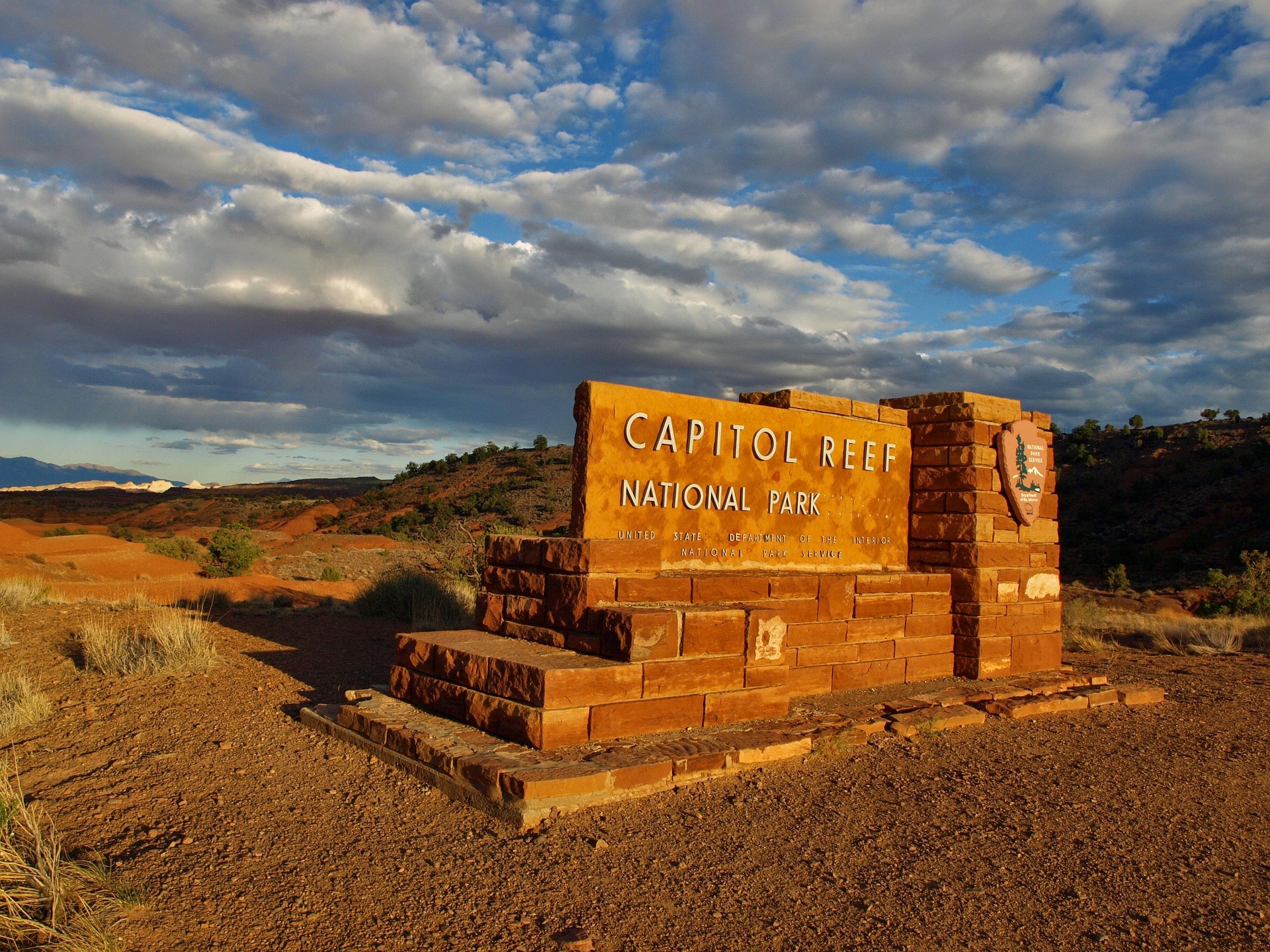
Torrey, Utah / Plan
Fees, permits, roads and timing
Plan a Capitol Reef Trip
Capitol Reef is the easiest of Utah's five national parks to walk into and the easiest to be caught out in. There is no ticket to buy and no queue to join, and there is also no cell signal, no fuel, no shop and one campground that books six months ahead.
The short version
Nothing to book, plenty to arrange
To plan a Capitol Reef trip you need to settle four things, and only one of them involves the park itself. Where you are sleeping, because the town outside has a small bed count and the campground inside is fully reserved. What you are driving, because 7.9 miles of road here are paved. When you are coming, because half the businesses in town shut for winter. And whether you are hiring anybody, because a good share of what gets sold as a Capitol Reef tour happens on the ground next door.
The park will not stop you at a gate, will not sell you a timed slot and will not make you queue at 6am for a parking space. After Zion and Arches, that comes as a genuine surprise. The tradeoff is that everything you might need, from fuel to a phone signal to a doctor, is somewhere else.
If you only read one other page, make it where to stay. Lodging is the constraint that decides your dates, and everything else arranges itself around it.
The full inventory
What actually costs money here
Most of Capitol Reef is free, and the free parts include almost everything visitors photograph. Here is the whole list, so you can see exactly where the money goes and where it does not.
| What | Cost | How it works |
|---|---|---|
| Driving Highway 24 through the park | Free | No gate, no station. The visitor center, Fruita, the orchards, the petroglyph panel and the Hickman Bridge trailhead are all on this stretch |
| The Scenic Drive | $20 per vehicle | Valid seven days. Pay at the self pay station just south of the campground, at the visitor center, or through pay.gov. $15 for a motorcycle, $10 per person on foot or bicycle, and under 16 free on foot or bike |
| Annual Capitol Reef pass | $35 | Pays for itself on a second visit. The America the Beautiful pass also covers you, and its price varies by type |
| Canyoneering permit | Free | By email, one per route per day, groups capped at eight. See the canyoneering guide |
| Climbing permit | Free | Same system as canyoneering |
| Backpacking permit | Free | Collected at the visitor center before you start. Required for any overnight in the backcountry |
| Fruita Campground | $25 a night | Reserved on recreation.gov six months ahead. Half price for Senior and Access pass holders |
| Fruita group site | $125 a night | Up to 40 people, mid April to mid October, bookable up to twelve months out |
| Cathedral Valley and Cedar Mesa campgrounds | Free | Six and five sites, first come first served, pit toilets, no water. See the camping guide |
| Dump station | Free, or $5 | Free with a campsite reservation, $5 without one |
| Eating fruit in the orchards | Free | Sample as much ripe fruit as you like inside any unlocked orchard |
| Carrying fruit out | By weight | Weighed and paid at a self pay station in the orchard. See the harvest guide |
The full breakdown of who pays what, including pass types and the fee free days, is on what Capitol Reef costs to enter.
Paperwork
Every permit, and whether it applies to you
Capitol Reef has no lottery and no quota on anything a visitor would want. Every permit below is free, and most people need none of them.
You need nothing if you are
- Driving Highway 24 or the Scenic Drive.
- Walking any marked trail, including Hickman Bridge and Cassidy Arch.
- Picking fruit in the orchards.
- Camping in a reserved site at Fruita or at either free primitive campground.
- Driving any of the backcountry roads in a suitable vehicle.
You need a permit if you are
- Descending a technical canyon. Free, by email, one per route per day, eight people maximum.
- Rock climbing or bouldering. Same system.
- Sleeping anywhere in the backcountry. Free, from the visitor center.
- Guiding anyone commercially. That is a commercial use authorization, and it is the operator's job, not yours.
- Getting married, scattering ashes or running an event. That is a special use permit.
The one date sensitive rule worth knowing before you book anything: the park closes a named list of canyoneering routes for part of every year, and in 2026 that ran April 1 to August 31, covering most of the visitor season. The list is set annually. Every permit explained has the detail.
Timing
When to come, and what that changes
Two elevations matter here. Torrey sits at 6,837 feet and Fruita, down in the park, sits near 5,400. That gap is why a summer evening in town is pleasant while the canyon floor is still hot.
| Season | Conditions | What is happening | The risk |
|---|---|---|---|
| March to May | Cool mornings, warm afternoons, backroads drying through April | Orchard blossom in April. Businesses reopen through March | Canyon closures start April 1. Mud after storms |
| June to August | Hot on the canyon floor, comfortable in town, monsoon storms from mid July | Apricots from late June, peaches from late July, pears from early August | Flash flooding. Never enter a narrow canyon with rain in any part of the forecast |
| September to October | The best of the year. Warm days, cold nights, reliable roads | Apples run mid August to mid October. Heritage StarFest lands on the darkest weekend | Lodging fills. This is the month to book early |
| November to February | Cold and quiet, with snow on red rock worth seeing | The park stays open. Much of Torrey does not | Highway 12 tops out at 9,600 feet on Boulder Mountain and can be hazardous |
The orchards run the calendar
Which orchards are open for picking changes week to week and is only reliably knowable by phone. Call 435 425 3791, press #1 for information then #5 for the fruit hotline. Fenced orchards open 9am to 5pm and unfenced ones from dawn to dusk. The harvest guide has the varieties and the windows.
The winter thing people miss
The Park Service warns that many local businesses close during the winter off season and on Sundays year round. The park itself never closes. So a February trip works, it just needs a phone call to whoever is feeding you.
Practicalities
Fuel, food, signal and help
There is none of it inside the park. All of these figures are Park Service distances measured from the visitor center.
| What you need | Nearest | Distance | Notes |
|---|---|---|---|
| Fuel | Torrey, or Hanksville going east | 11 miles west, 37 miles east | None inside the park. Fill up before a backroad day |
| Groceries | Torrey for a general store, Loa for a full supermarket | 11 miles, 28 miles | The Park Service describes Torrey groceries as seasonal and Loa as year round |
| Cell service | Torrey | 11 miles | The Park Service states plainly that cell service is not available in the park. There is a 911 payphone at Fruita Campground and free WiFi at the visitor center |
| A doctor | Wayne Community Health Center, Bicknell | 18 miles west | Basic medical, dental and pharmacy, on 435 425 3744 |
| An emergency room | Sevier Valley Hospital, Richfield | Well beyond the county | The nearest hospital is outside Wayne County. In county care is the Bicknell clinic, so factor the drive into anything ambitious in the backcountry |
| Laundry and showers | Torrey, and Loa for laundry | 11 miles, 28 miles | Showers for a fee at Chuckwagon Lodge in Torrey, March to October. Fruita Campground has none |
Two navigation warnings
The Park Service says GPS is unreliable here and recommends carrying a paper map. It also marks South Draw Road as not recommended, which is unusual language for a land manager and worth taking at face value.
Download your maps before you leave Torrey, because you will lose signal at the park boundary.
Getting here
Highway 24 runs east and west through the park, and Highway 12 climbs south over Boulder Mountain toward Escalante and Bryce. That road is a genuine All American Road and it is also the one with a 9,600 foot summit, so treat it as a winter hazard rather than a scheduled closure.
Nearest airports are Salt Lake City at roughly three and a half hours and Grand Junction at about three. Full detail on getting to Torrey and Scenic Byway 12.
Straight answers
Planning questions
Do I need a reservation or timed entry ticket for Capitol Reef?
No. There is no reservation and no timed entry ticket needed to enter Capitol Reef, unlike Arches. You drive in. The only thing that needs booking ahead is a campsite.
How much does Capitol Reef cost to enter?
Twenty dollars per private vehicle, valid seven days. The fee is charged for the Scenic Drive, and you can pay at the self pay station there, at the visitor center or through pay.gov. There is no gate on Highway 24, so a visit that never uses the Scenic Drive may never pay it.
Is there cell service in Capitol Reef?
No. The Park Service states that cell service is not available in the park. The nearest service is in Torrey, there is a 911 payphone at Fruita Campground, and the visitor center has free WiFi. Download maps and confirm plans before you drive in.
How many days do I need at Capitol Reef?
One day covers the Scenic Drive, Hickman Bridge, the petroglyphs and the orchards. Two lets you add a backroad day out to Cathedral Valley. Three is where the Waterpocket district and a guided trip start to fit. See the one day plan.
When is the best time to visit Capitol Reef?
October, then late April and May. Autumn brings warm days, cold nights, reliable backroads and the apple harvest. Summer is workable with early starts, and the risk is monsoon flash flooding from mid July. See the month by month guide.
Can I visit Capitol Reef in winter?
Yes, and it is the quietest and one of the most beautiful times here. The park never closes. Plan around the fact that many Torrey businesses shut for the off season and on Sundays, some backroads become impassable, and Highway 12 over Boulder Mountain tops 9,600 feet.
Is Capitol Reef good for children?
Unusually so. The orchards, the petroglyph boardwalk and the Gifford House are all short, flat and free, and there is no shuttle queue to manage. See Capitol Reef with kids for the trips that take children and at what ages.
Fees, permits, distances, road grades and the cell service statement on this page come from the National Park Service pages for permits and reservations and local services, checked September 2026.
Next step
Work through it in this order
Bed first, because it is the tightest constraint. Then dates, then vehicle, then anything you are hiring.
Also useful before you set off: road conditions, fees in detail and the Torrey town guide. Or read who writes this site.