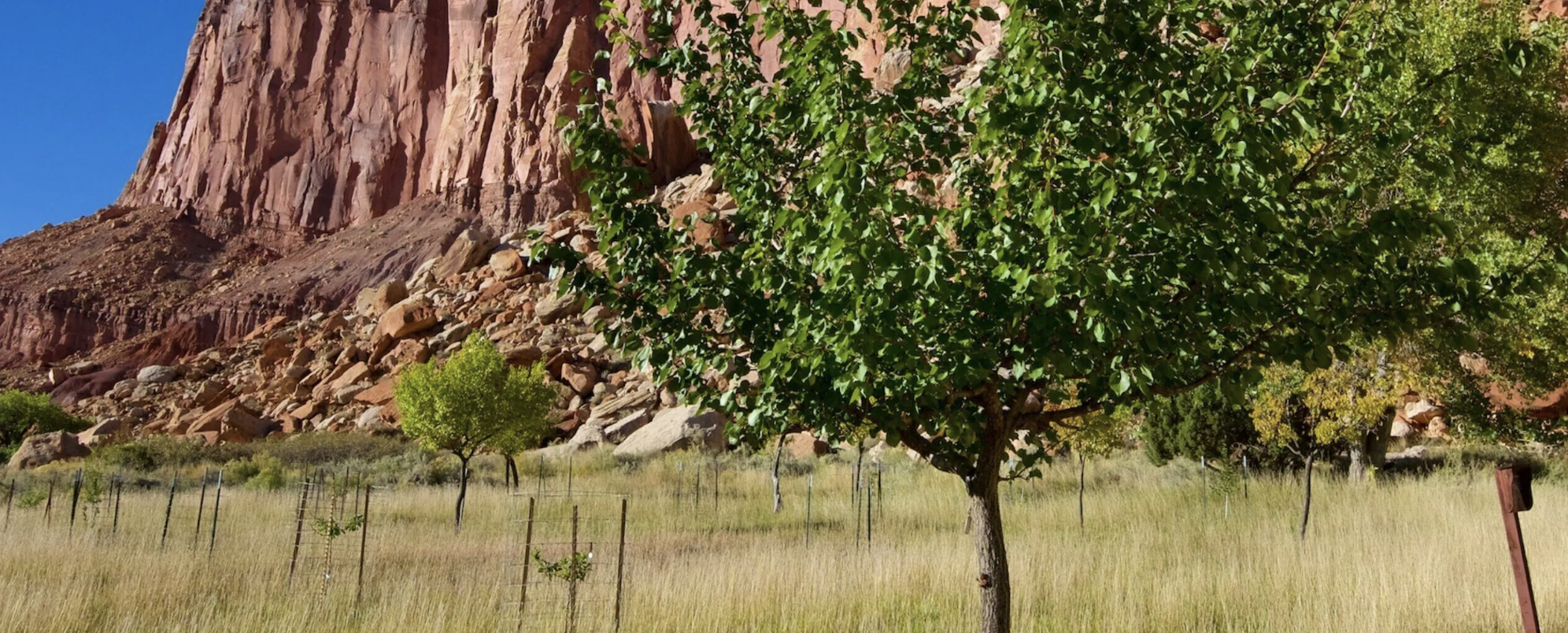
Torrey, Utah / Things to do / Fruita orchards
The only orchard in the national park system you can pick from
The Fruita Orchards
The Fruita orchards are 19 separate orchards with names, and each one holds different fruit. Almost nothing online tells you which is which, so visitors wander into a pecan grove in August wondering where the peaches are. This page lists all 19, the fruit in each, the four harvest windows the Park Service will commit to in writing, and the phone sequence that actually reaches the fruit line.
If you read one section
Eating is free. Taking it home is not
The Park Service puts it in two sentences. There is no charge for fruit consumed in the orchards. And fruit taken from the orchards must be paid for. You are welcome to stroll in any unlocked orchard and sample ripe fruit there, whatever the season, whether or not anything is officially open for harvest.
Picking to carry out is different. Fruit may not be harvested and taken from the orchard until that orchard is posted as open for picking, and the park asks you to harvest only from orchards showing a U Pick Fruit sign. When one is open, a self pay station with scales, bags and a sign listing prices sits near the entrance. Prices are set per pound, they change by fruit and by season, and the park does not publish a fixed number, so read the sign rather than trusting a figure you found on a blog.
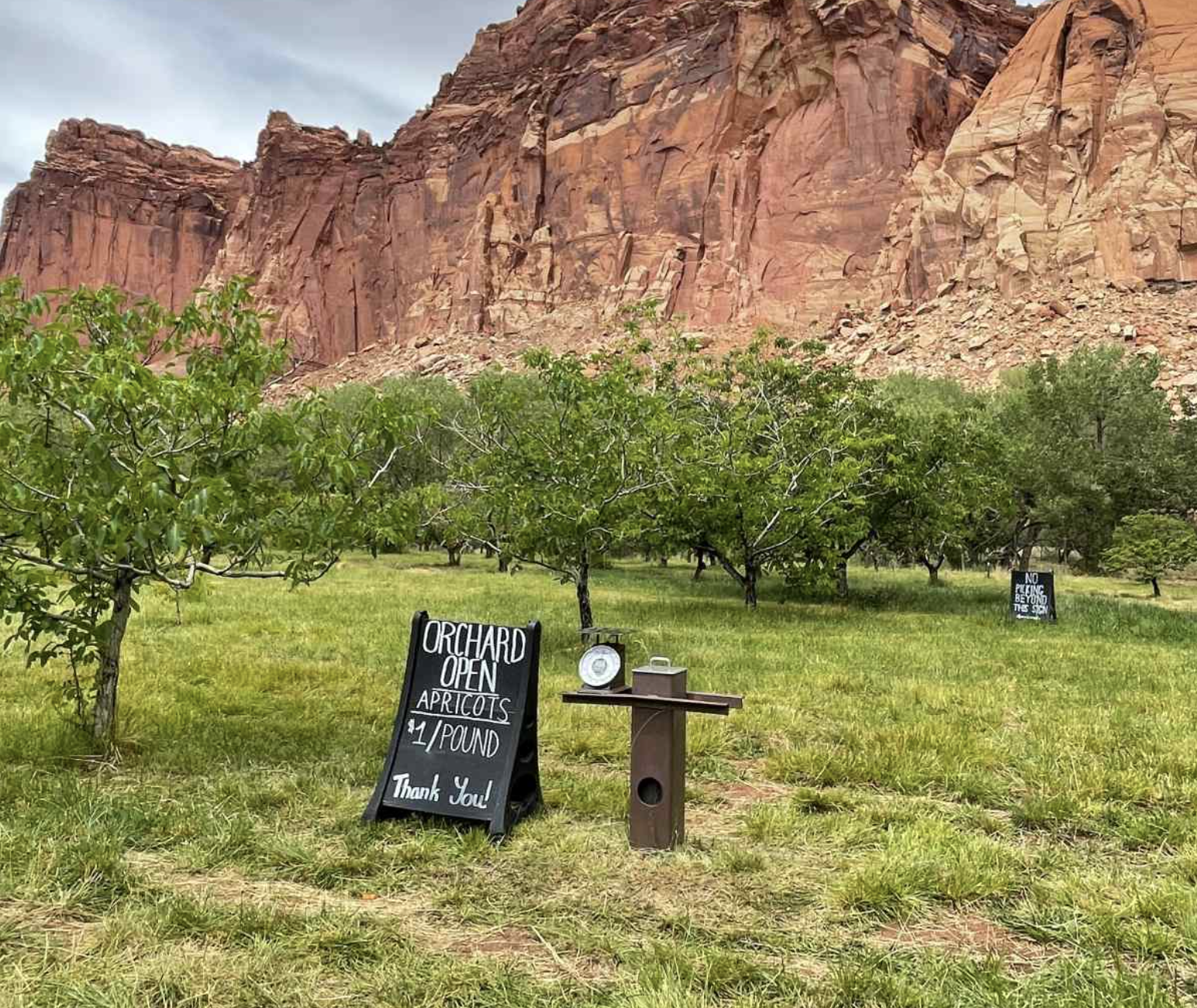
To give you a sense of scale rather than a rate to plan on: the photograph below shows one of those boards, and on the day it was taken it read apricots, one dollar a pound. Treat that as a single observation from a single orchard on a single day. It is not the park's published price, because there is no published price, and it will not be the number on the board the day you arrive.
Whether anything is open today is the one thing you cannot work out from home. Call 435 425 3791, and after the introduction press #1 for visitor information then #5 for the fruit hotline. That double key sequence matters. A lot of pages print a single digit and it does not get you there.
Harvest is the reason a lot of people pick their dates. If yours are still open, the month by month page sets harvest against thirty years of park weather data, and the planning hub sequences a trip around it.
Four windows, and the ones nobody will promise
When the fruit is actually ripe
The park's own orchard bulletin commits to four harvest windows and no more. Everything else you see published is somebody's guess dressed up as a schedule. Here is the split, stated honestly.
| Fruit | Typical window | What that means for your trip |
|---|---|---|
| Apricots | Late June to mid July | The shortest window of the four and the easiest to miss. Roughly three weeks in the hottest part of early summer |
| Peaches | Late July to early September | Overlaps the monsoon. Good odds across six weeks, with afternoon storms as the main scheduling problem |
| Pears | Early August to early September | Sits inside the peach window, so a late August visit can catch both |
| Apples | Mid August to mid October | Two full months, the longest and most reliable window, and it runs into the best hiking weather of the year |
| Cherries, plums, mulberries, nuts | Not published | These trees exist and they fruit, but the park does not publish a window for them. Individual year announcements have put cherries in June, which is a single year's news release and not a schedule |
Those four windows are the park's words, not a range someone averaged. They are also described as typical, which is the operative word in a high desert valley. A cold spring pushes everything late, a hard frost during bloom removes a crop entirely, and the hotline is the only thing that knows which happened this year.
The sweet spot, if you want to choose
Late August into the first half of September catches apples and pears together, usually the tail of the peaches, warm days, cool nights and the monsoon winding down. It is also when the cottonwoods along the Fremont River start to turn. If harvest is the reason for the trip, that fortnight is the one to book.
And the trip nobody plans
Blossom is the other half of the year and it draws almost no crowd. The trees flower in spring, the orchards are unlocked, and you can walk through all of them without a soul around. Nothing to pick, but the best photographs of the year and empty trails a mile away.
The list that is not anywhere else
All 19 orchards, and the fruit in each
The park publishes this on a map in a site bulletin most visitors never see. Each orchard carries the name of the family who planted or worked it. If you are hunting a specific fruit, this is the table that saves you an hour of wandering.
| # | Orchard | What grows there |
|---|---|---|
| 1 | Mott | Almond, apple, apricot, cherry, mulberry, peach, pear, plum, walnut |
| 2 | Jackson | No species listed on the park's map |
| 3 | Guy Smith | Apple, grape, peach, pear |
| 4 | Abie Clarke | Apple, cherry, peach, walnut |
| 5 | Cook | Apple, apricot, cherry, peach, pear |
| 6 | Amasa Pierce | Apple, apricot |
| 7 | Behunin | Apple, apricot, plum, pear |
| 8 | Merin Smith | Apple, apricot, cherry, pear |
| 9 | 'Tine Oyler North | Pecan |
| 10 | 'Tine Oyler South | Apple, cherry, peach, pear, plum |
| 11 | Holt | Apple, cherry, pear |
| 12 | Max Krueger | Apple, peach |
| 13 | Adams | Apple, apricot |
| 14 | Johnson | Almond, apple, apricot, cherry, peach, pear, plum, quince, walnut |
| 15 | Doc Inglesby | Apricot, cherry, grape, pear |
| 16 | Gifford | Apple, apricot, peach, pear, walnut |
| 17 | Chesnut | Almond, apple, pear |
| 18 | Cass Mulford | Apricot |
| 19 | Carrell | Peach |
Two things worth reading out of that table. Mott and Johnson are the diverse ones, nine species apiece, which makes them the best bet if you have one hour and want to see the range of what a Fruita family grew. And the nut trees are real: almonds in three orchards, walnuts in four, pecans in 'Tine Oyler North. Nobody comes here for pecans, which is precisely why that grove is quiet.
An orchard being on this list does not mean it is open for harvest, or that it is fruiting this year. Species recorded on a map and fruit on a branch in September are two different things, and the hotline is what connects them.
Short, and all of it enforced
The rules, in the park's own words
Yes
Stroll in any unlocked orchard. Sample ripe fruit there at no charge. Harvest from orchards posted as open with a U Pick Fruit sign, weigh it at the self pay station and pay the posted price. Use the ladders and picking poles the park provides when an orchard is open.
No
Never climb the trees. These are historic plantings and a broken limb is a permanent loss. Do not harvest from an orchard that is not posted open. Take only ripe fruit and leave the rest for the next visitor. Do not carry fruit out without paying for it.
Hours differ by orchard type, which catches people out. Fenced orchards are open 9:00 am to 5:00 pm. Unfenced orchards are open dawn to dusk. So a sunrise walk is possible in some of them and not others, and the fence is the tell.
On the ladders: the park's guidance is worth following literally. Set the ladder on firm level ground with the third leg fully extended and the chains pulled tight, do not stand on the top three rungs, and do not lean to either side. Children need supervision. Orchard ladders are tripods, they behave differently from a stepladder, and the ground under an irrigated orchard is softer than it looks.
The orchards are flood irrigated through ditches dug in the 1880s, and the park still runs water down them. If the grass is wet or a ditch is flowing, expect mud, wear shoes you do not mind ruining, and do not set a ladder in soft ground.
The part the brochures leave out
The orchards are smaller than they were, and the park says so
This matters to your trip, because it explains why a fruit listed on the map may not be available in the orchard you walked into.
In its orchard rehabilitation planning documents, the Park Service describes the progressive loss of nearly 1,000 fruit trees over the past decade due to age and disease coupled with minimal replanting success. That is the park's own sentence about its own orchards, and the per orchard numbers are blunter.
| Orchard | Trees in 2012 | Trees in 2020 |
|---|---|---|
| Cook | 204 | 55 |
| Guy Smith | 217 | 15 |
Cook and Guy Smith became the pilot project for replanting, about 4.6 acres, roughly 12 percent of the existing orchard area. Mott and Carrell are named as candidates for the near future. The replanting is real and it is happening: the park records 260 peach trees planted in 2022 and 211 cherry and apple trees in 2023.
So the honest picture is an orchard system that lost ground for a decade and is now being rebuilt tree by tree. Young trees do not crop for years. That is the actual reason a September visit can find fewer orchards posted open than the map suggests, and it is worth knowing before you drive four hours for peaches.
Sizes vary between park sources, and rather than pick one, here are both. A public park page describes 100 acres of orchards and pastures with approximately 1,900 trees. The 2021 rehabilitation assessment counts about 40 acres of orchards intermixed with about 25 acres of fields and pasture. The figures are drawn on different boundaries. Another park page has said over 2,000 trees. We use about 1,900 because that is the current number on the park's orchard page.
Practical
Doing this well in half a day
Where the orchards are
All of them sit in the Fruita historic district, in the green river bottom where the Fremont River runs below the cliffs, clustered around the visitor center and the start of the Scenic Drive about 11 miles from Torrey. You do not need a backroad vehicle or a permit. You park and walk in.
The park charges an entrance fee, payable at a self pay station, at the visitor center, or online at pay.gov, and it is valid seven days. The fee page has the amounts and the passes that cover it.
Pair it with the Gifford House
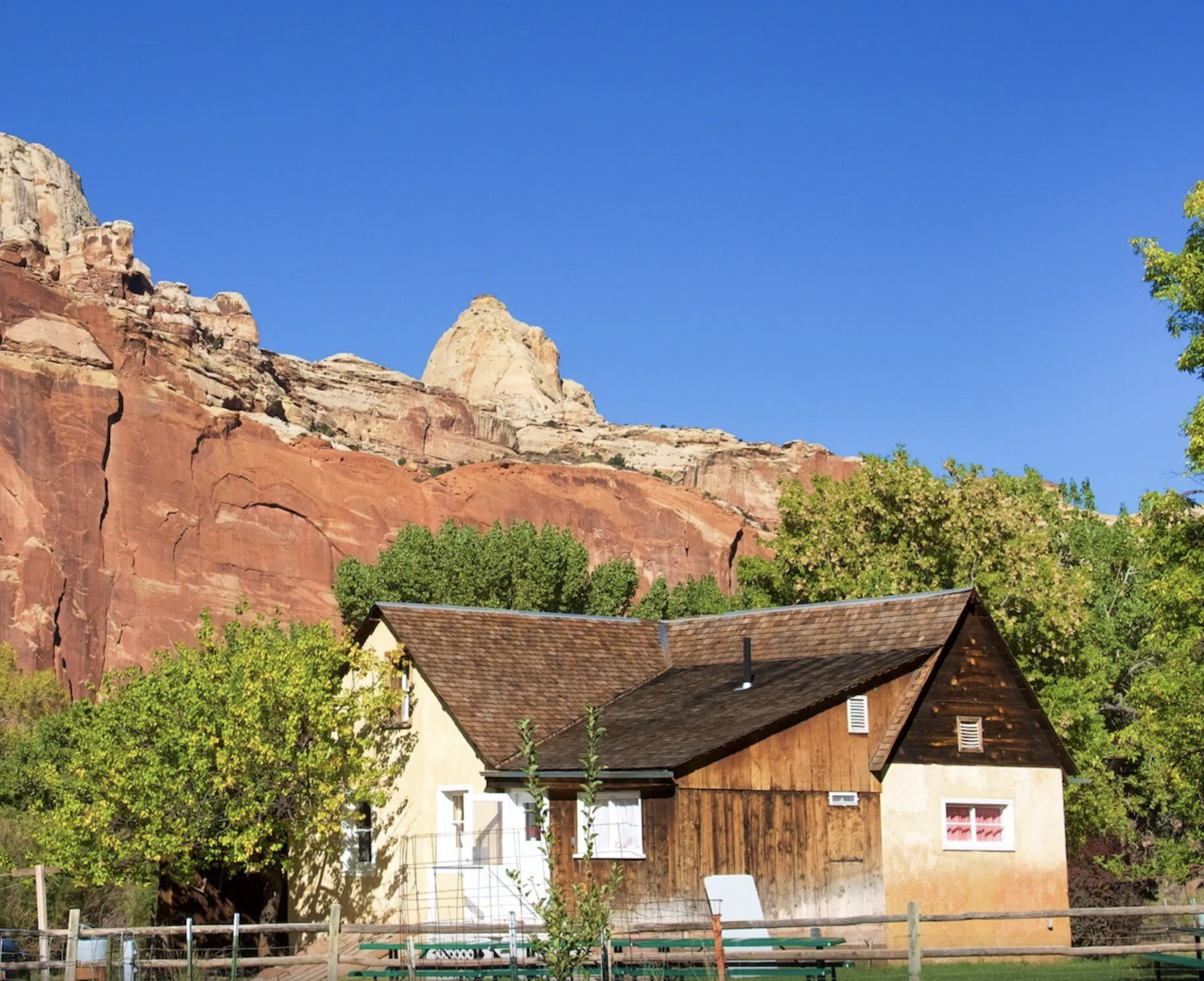
The Gifford House sits in the same meadow and sells the pies that most people actually remember from Fruita. It is also where the park sells firewood seasonally, which matters if you are camping at Fruita, a few hundred yards away among the orchards.
Lines at the Gifford House get long by mid morning in summer. Orchards first, pie second, is the better order.
Half a day covers it comfortably: walk two or three orchards, pick if anything is posted open, see the Gifford House, and add an easy trail from the same parking. The Fremont River Trail and the Cohab Canyon trailhead are both right there, and the hiking page lays out which trails start where. Families tend to get the most out of the orchards of anything in the park, and the kids page builds a day around that.
One honest note on timing. The orchards are not a rain or shine activity in July and August. Afternoon thunderstorms arrive most days in the monsoon, the ditches run, and a tripod ladder in wet ground is a bad idea. Mornings, always, in summer.
If you want the history rather than the fruit, the short version is that Latter Day Saints settlers reached this valley in 1880 and planted thousands of trees, and most of the orchards standing today were planted by Fruita residents between the turn of the twentieth century and the 1950s. The last families sold to the park in the 1960s. The ditches are the original ones.
Straight answers
Orchard questions
Can I pick fruit at Capitol Reef right now?
Only if an orchard is posted open with a U Pick Fruit sign. Call 435 425 3791 and press #1 for information then #5 for the fruit hotline, or ask at the visitor center. You can always walk in an unlocked orchard and sample ripe fruit there, at any time of year, at no charge.
How much does the fruit cost?
It is priced per pound and the price is posted on a sign at the self pay station next to the scales, alongside bags. The park does not publish a fixed rate, and it differs by fruit and by season, so read the sign rather than a number from a travel blog. Fruit you eat in the orchard is free.
What are the Fruita orchard hours?
Fenced orchards are open 9:00 am to 5:00 pm. Unfenced orchards are open dawn to dusk. Harvesting is only allowed in orchards posted as open for picking.
When are the apples ripe at Capitol Reef?
Mid August to mid October in a typical year, the longest of the four windows the park publishes. Apricots run late June to mid July, peaches late July to early September, and pears early August to early September. All are described as typical and all move with the weather.
Are the cherries pickable, and when?
Cherry trees grow in at least seven of the 19 orchards, but the park does not publish a cherry harvest window the way it does for apricots, peaches, pears and apples. Individual year announcements have put cherries in June. Treat that as one year's news rather than a schedule and call the hotline.
Do I need a reservation or a permit to pick fruit?
No. There is no reservation system and no permit. You need the park entrance fee, and you need an orchard that is posted open if you want to take fruit away with you.
Can I bring my dog into the orchards?
Pets are allowed in the developed areas of the park and must be on a leash six feet or shorter at all times. They are not allowed on park trails, so plan the orchard walk and the hiking separately.
Is the fruit picking wheelchair accessible?
Partly. The orchards are flat and grassy with mown paths rather than paved ones, and irrigation means the ground can be soft or wet. Getting in is usually straightforward from the parking areas, reaching fruit on a ladder is not. We have not found a park statement rating orchard accessibility, so call the visitor center if this decides your visit.
Harvest windows, orchard names, species, hours, the hotline sequence, tree counts and the rules on this page come from the National Park Service, primarily the park's orchards page and its Capitol Reef Orchards entry, plus the park's orchard site bulletin and orchard rehabilitation planning documents, checked September 2026. Crops change every year, so the hotline is the live answer.
Next step
Build the trip around the harvest
Fruit picks the fortnight. The rest of the trip is what you do with the other six days of the entrance pass.
Also useful: where to eat in Torrey, today's road conditions and the town itself. Or who writes this site.